Friday, 16 July 2010

Knives like these are not available outside of Japan!


this is my new knife, hand made in Tokyo, with my name engraved on it! One of my fellow Sous chefs at Zuma bought it back for me from a recent trip to Japan,he really knows what he is talking about when it comes to knives, he was trained in Japan and frequently tells of stories of how he spent the first 6 months of his apprentaship sharpening the knives of every chef in the kitchen, he would arrive at work at 6 in the morning and sharpen every one of the chefs knives! Until they were all happy that he knew how it was done properly, frequently they told him ''it's not right, do it again'', until they were content that he could sharpen each knife properly, then he spent another month sharpening them, just to make sure!
I asked him to buy me a good Sashimi knife and that is what he did! It feels amazing to use, it is relatively light but razor sharp, I have been using it for 3 days now without sharpening it and tonight it still felt as sharp as a razor! It slices through Tuna and Salmon as if they were soft butter.
Good tools are essential to good cooking. Sharp knives of good quality steel are essential to the professional cook, they seperate the Pros from the Ams! In the completely outfitted French kitchen, for example, the array of instruments range from large tools for meat and poultry, including cleavers to split large pieces of meat and straight-bladed choppers for breaking light bones, to a battery of knives for chopping, peeling,, and paring, to all-purpose utility knives. Asimilar varied group of knives is to be found in the Japanese kitchen. Of course, the shapes of Japanese knives are different from those of the West because blade shapes evolve in conjunction with native techniques of food preperation and indigenous foods.
My Sashimi knife is specially designed for slicing meat and mainly fish.
It was expensive, £164 to be pracise, but if I look after it well, and I will, it will last me a lifetime and I will not have to buy another, so to me it was worth every penny!

Saturday, 10 July 2010

The Worlds first Celebrity Chef-Burried at Kensal Rise Cemetery!


Names like Escoffier, Ducasse and Ferran Adria will be remembered for decades probably centuries to come.... However, there is a chef that very few people would have heard of, yet in today's terms, he might be called ''The Worlds first celebrity Chef''!
Alexis Benoist Soyer was born in Rue Cornillion, Meaux en Brie on the 4th of February 1810. The youngest son of Emery Roch Alexis Soyer and Marie Madelaine Francois Chamberlon.
Alexis was born into hard times, his Father took on several jobs, even as a labourer. Two older brothers died in childbirth, leaving two other brothers, Philippe and Louis. It was rumoured that his mother wanted Alexis to join the church, however he had other ideas, by the age of just nine he joined his brother Phillip in Paris, who was already an established chef. By the age of just seventeen, Alexis was a celebrated chef with twelve junior chefs working under him! For various reasons in 1831, Alexis left Paris for England, again to join his brother who was now chef for the Duke of Cambridge.
In five short years Alexis had quickly established himself with nobility and became a chef de cuisine of note. In 1838 he was offered the job of chef at the newly formed Reform club, where he helped to design the kitchen. In the same year Alexis married the love of his life, the celebrated artist Elizabet Emma Jones or Emma as she was preferred to be known, she was admired for he work rate and she was first exhibited at the Royal Academy aged just ten! Alexis was madly in Love with Emma, admiring her passion and dedication for her art, much like himself. He was distraught after her premature death at the age of just thirty two in 1842,she was a passionate women but with a delicate soul and died of freight! During a thunderstorm! She was about to give birth to Alexis first child who also died under these freak circumstances.
Alexis was devastated of the death of his lover and had a large tombstone built for her in Kensal Rise cemetery (where my pictures were taken this morning!), where he was to join her a few years later.
Whilst at the Reform Club, on hearing about the plight of the Irish peasants during the 1847 potato famine, Alexis was asked for help by the British government for help. Alexis went to Dublin and set up the first ever soup kitchen, which in its peak, served up to 5000 people a day! It is claimed that Alexis efforts were fundamental in saving several hundred lives. He also opened an art gallery, showing pictures of his lost loves paintings, it was named ''The Soyar Philanthrophic Gallery'', he used the profits made from the gallery to set up several more soup shops around London.
During his life Alexis was a prolific author, he wrote eight books in all, and his ''Instructions for Military cooks'' was published in 1860. With various titles of his cook books he reached all areas of society. On his death a creditor named David Hart, a wine merchant, seized all of Alexis goods, now all of his paperwork and notes of his life have been lost, therefore, because of David Hart, very little about Soyer is left, he received no rewards from his adopted country for all his humanitarian deeds! He is simply the chef that time forgot, yet during his life he was known as the best chef in the World.

Saturday, 3 July 2010

Scallops.


Scallops are one of my favourite things to eat in the whole world! The are a delicate, sweet, soft muscle, they taste amazing, cooked or raw, they are a bit pricey, but then you have to pay for quality. For me they are the beef fillet of the shellfish world, no fat, just really soft meat, or in a Scallops case, muscle. Yet, in Britain we don't really eat much of them, fair enough it may be a bit tricky getting hold of them, never, ever, ever,ever buy them from a supermarket, they are shit, and if you have never tried them before you will be wondering what the fuss is about, you may have to venture out to your local fishmongers. Another reason for Brits not really eating allot of Scallops is that shellfish can, I suppose, look a bit intimidating, a little bit difficult to get into or prepare, which works in its favour, as most shellfish, in fact all bare Lobsters, are still sustainable sources of fish, which experts say we should be eating more of so as to take the pressure off of other fish stocks, such as Plaice, Cod, Haddock, etc.
Diving for Scallops can be very dangerous, the divers are experienced and knowledgeable about where to find healthy stocks, this is partly the reason for their fairly high price, but diving for them is much friendlier to the environment than using a large trawler as the divers select only the large Scallops and leave alone the smaller ones in order to grow and maintain a healthy stock, plus the divers cause very little damage to the environment, as apposed to a trawler churning up the seabed!
Scallops have been known to live up to 20 years! but usually the xxl Scallops we use in the restaurant live to around 10-12 years, which is still amazing! As a Scallop grows, you can count the rings on its shell in order to tell its age (similar to that of a tree trunk!), in a good year, when there is plenty of food about, the Scallops will grow faster and larger.
As a general rule (well, my general rule) when it comes to cooking them, the less you do to a Scallop the better, there is nothing worse than eating a Scallop in a restaurant that has been played around with, rolled in this and that, served with a foam, espuma or jelly, aaarrrhhhhh! Just let them serve themselves, I simply open them by putting them on a chopping board, flat side down and sliding a sharp knife between the gap in the shell, angling the knife slightly downwards so as not to cut into the Scallop meat, then remove the skirt and the coral (I usually leave the coral on if it is not spawning, between the months of may and September, it can be beautifully sweet, yet if it is spawning, large, mushy and not very nice to eat! So in this case it can be removed), I leave the white muscle attached to the shell, this almost acts like a natural bowl! Then simple grill them, over the highest heat achievable, hot and fast is the secret here, then I serve them with something really simple, just a few ingredients, here are a few ideas:
-Garlic, parsley, olive oil and grated lemon rind and juice.
-Thai fish sauce, finely sliced Birdseye chillies and freshly squeezed lime juice.
-A simple Beurre noisette ( butter, browned in a pan until it is almost burned)!
They are also great served raw! Simple sliced thinly, layed on a plate and dressed with soy sauce or Yuzu juice, a Japanese citrus fruit kind of a cross between a lemon and a grapefruit, or just olive oil, lemon juice and salt and pepper.
More interesting ''Scallop'' facts!
-The roe on a scallop can contain up to 100 million eggs when it is spawning! And will change size throughout the year!
-Scallops are Hermaphrodites! The ''orange segment'', known as the roe contains the Scallops eggs, and its creamy coloured tip contains its sperm!
-Unlike Oysters and Muscles, Scallops don't need to anchor themselves onto rocks, piers or coral, they prefer to move about and can be speedy little thing! Once parked on the seabed they will lie flat side down, covering themselves in a thin layer of sand for camouflage and move around the seabed several times a day!
So, that's Scallops, now I am off to buy a few for my lunch!

Monday, 28 June 2010

What is Tofu?


At Zuma, we regularly use tofu, we make fresh tofu and also serve tofu deep fried in a flour mixture which includes shichimi pepper, black sesame seeds and Katakuriko (a fine potato starch). But what actually is Tofu? I know that it is made from Soya milk and that it is really good for you, but that's about all I knew, until now! So I done some research and here is what I found.
It actually originated in China over 2000 years ago! Where its use spread throughout the Far East so far that even today from Indonesia to Korea and Mongolia no national cooking does without it! Tofu, or bean curd, as it is often known, was probably introduced into Japanese cuisine around the 18th century. Nowadays the ''regular'' Japanese type of Tofu is made to suite Japanese tastes, it is softer, whiter and has a more delicate taste than the Chinese variety.
''Regular'' Tofu is soft and easily digestible. It is an ideal food for dieting, having an extremely low ratio of calories to protein, an average 180g portion contains only 100 calories, but 6% protein. Tofu is low in carbohydrates and completely free in cholesterol!
So how is is made????????????? Tofu is made from dry soya beans, which are soaked in water until they turn soft, then they are crushed , then boiled. Then the crushed material is separated into pulp and milk, the pulp becomes a tofu by-product called ''Okara'', a food in its own right. To the soy milk is added a coagulant to make the milk separate into curds and whey. Fresh warm curds are then poured into moulds and then left to settle for a few hours to take shape, the tofu is then soaked in water to firm even more, to cool and to keep fresh.
In Japan, Tofu is usually eaten fresh on the day that it is made, as daily shopping still exists as a part of Japanese life. Shopping habits are now different in most countries nowadays, and here in London we find tofu in plastic tubs, date stamped like milk, in order to give the consumer an indication of freshness, It should be consumed within 5-7 days of being made, and must be kept under refrigeration.
So I hope that my research has cleared up a few of the mysteries of Tofu!

Art Muay, a piece of Asia in Earls Court!


At Nahm, there would frequently be problems with our delivery of Thai produce (it isn't easy transporting all of those ingredients from a Market in Thailand to a small Hotel in Belgravia!), usually because of a Riot, Protest or some other form of demonstration in Bangkok, so as all of the dishes used authentic ingredients and strict recipes were followed, no compromise was ever made, only Thai herbs, spices and other amazing ingredients were ever used. So when this problem did occur, we (the chefs)would take it in turns scouring London for the little Thai produce available. Most of the time we would head over to China town, along with the other thousands of Thais living in London! Until we came across Art Muay, a small shop, down a small street in Earls Court. They always seem to have great quality produce, usually at a reasonable price. So here are a few pics I took on a recent trip.

Wednesday, 23 June 2010

What a mental day!


Mental Day in the kitchen, England playing and I'm on a double! So I arrived at work at 7.30 in the morning, 2 cigarettes, 1 bottle of Lucozade and a panini, then worked my nuts off all morning, racing round so that I could get out to watch the game, fucking busy lunch, then found another load of jobs that needed doing, then eventually slipped out to watch the second half, all the posh pubs in Knightsbridge were without telly's, so I ended up watching it in a bookies, with a load of working men , or not so working men! Good atmosphere though, well for a bookies, full of a load of divorced Irish men with drink problems! No, it was a good result for England, we actually looked like we could be arsed for once! So anyway, ran back to work, quickly got changed back into my chef whites, then set up and straight into a very busy service! Cleaned down, then it was 1 in the morning! Arrived home about 1.30, now I am shagged out,time to hit my bed, 2 days off, wahoooooooo! Might go to Vijiante on friday!

Monday, 21 June 2010

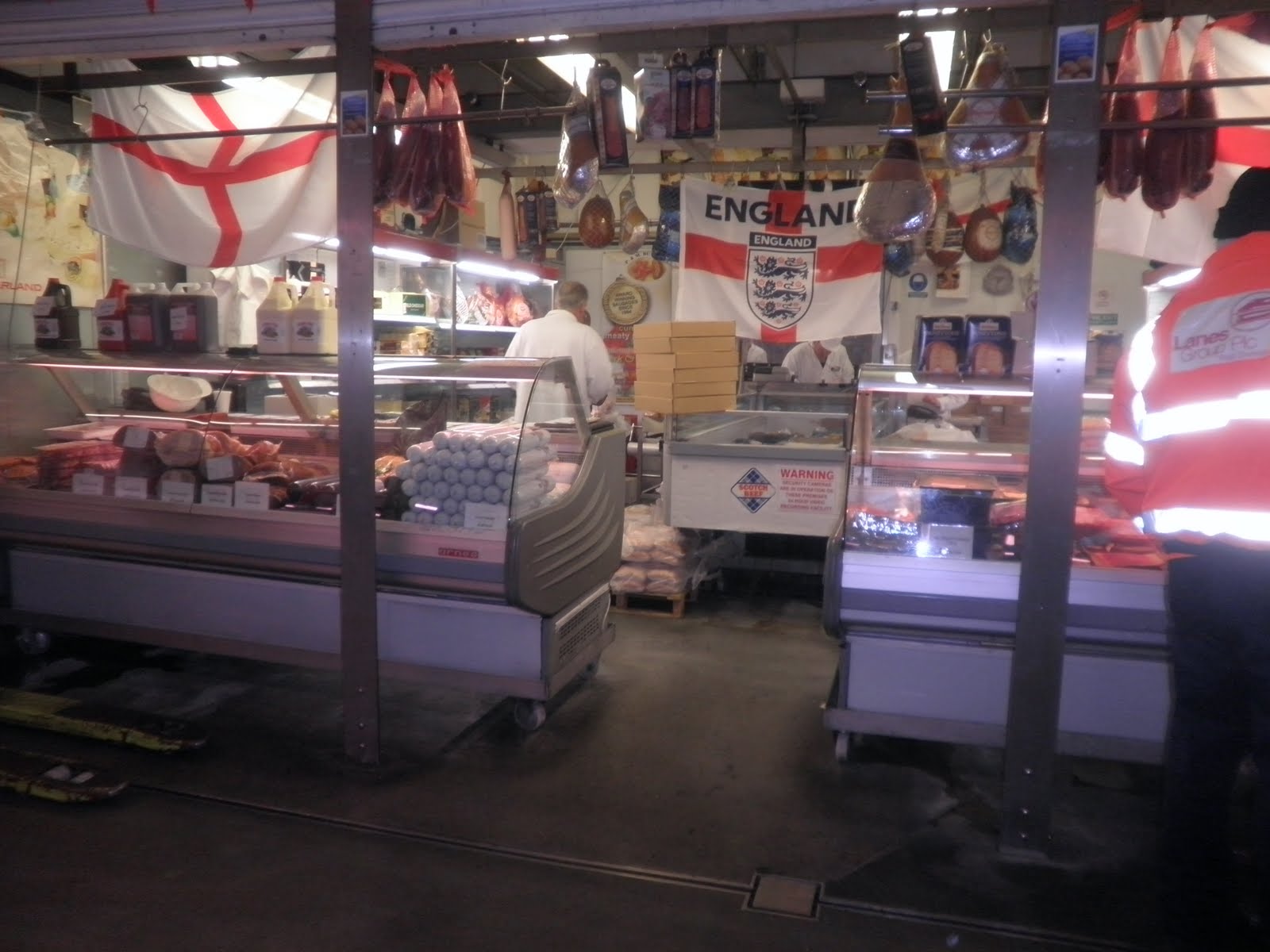
The ''Patriotic'' Smithfield Meat Market.


London has so many great food markets, yet unlike most other markets in the cities of Europe, London's main food markets are open during the hours that most of us sleep! So most of us rarely get to see what they have on offer, forget the expensive, yet trendy, farmers markets (although these are great!), I am talking about the real, hustle and bustle markets, where a real bargain can be found, and the traders really are passionate and knowledgeable about what they sell such as New Covent Garden vegetable market, Billingsgate fish market or Smithfield meat market, which I recently visited.

Originally known as ''Smoothfield'', there has been a livestock market on this site for more than 800 years! As early as the 12th Century it was used as a vast recreational area where jousts and tournaments (and no doubt, the occasional cock fight!) took place. By the middle ages the area had become the most famous livestock market in Europe.
There is also a darker side to the market, as from the early 13th century, it was used to execute criminals! Some 200 people have been executed there,mainly for their religious beliefs, most of them burned to death! Those executed include Wat Tyler, the leader of the Peasants revolt and more famously Scottish hero William Wallace, in 1305.
It was also the location of the Bartholomew Fair, 3 days, which over the years became the most debouched and drunken event in the holiday calender, even so it lasted over 700 years, until it was closed in 1855.

So theres a bit of history, now to my visit. Well Smithfield opens its doors to the general public at 3.....am, so you have to be a bit loopy to visit a market at 3 in the morning to save a few £s on some chicken legs! or be a chef, therefore you are used to never sleeping anyhow! Well, I had just worked two 16 hour shifts , back to back, but I wanted some meat for my World cup party, so we finished at 12.30 and therefore had 2 and a half hours to kill, so me and a few of my fellow chefs from Zuma marched off down to China town in the early hours to kill a bit of time.
then jumped on the bus and arrived there at 3, the market was already buzzing, full of stereotypical butcher like blokes, think fat, bald, cockney characters wearing butchers aprons, laughing and joking with one another, they all had time for me and answered all questions that I had to ask them, throwing the odd jokes in, here and there.
We spent a few hours browsing around the market, which is full of bargains, some of the best on offer were 50 chicken legs for £20, and a whole four rib of beef for £30! Bargains Gallore!
I picked up 2 Farmed Rabbits, 2 Veals kidneys and 2 kg of English diced chuck beef, all for about £32!
So I will definitely be visiting as often as I have the energy to and soon I Will do a post on New Covent Garden vegetable market and Billingsgate fish market.